.JPG)
Pieris napi
This species is widely-distributed throughout the county, but it is only common or fairly-common in parts of the Weald of Sussex and some of the major river valleys. It is mostly found in damp grassland and humid woodland rides, and tends to avoid dry, open habitats such as chalk downland. Small numbers can be found more-or-less anywhere in Sussex, including our gardens, but in most locations it is out-numbered by Small Whites and Large Whites.
Separating Green-veined White and Small White can be awkward at times, especially with older, faded individuals. With closed wings, the characteristic green veins of the undersides of the hindwing is diagnostic. With open wings the best way to separate these two species is to check the tip of the forewing. Small Whites have a small amount of grey (sometimes black) which is confined to the very tip of the forewing. Green-veined Whites also have a grey patch on the forewing tip, but this grey extends a-little-way-along the rear edge, forming a row of small triangular markings.
Between 2006-2024 the “average first sighting” was April 3rd (range February 18th to April 20th). This first brood peaks in mid-May and runs through to mid-June, sometimes into July. The second brood is on the wing from late July until early September. There is also an overlapping partial third brood from early September to late October.
In the last century, there was compelling evidence that Green-veined Whites very occasionally migrated from mainland Europe. In this century there have been several records of 20-50 Green-veined Whites, in coastal areas, in late summer. At this time of the year, if we see 40 of these butterflies at a coastal location (where we might normally see 1-2) then a fresh migrant flock is as good an explanation, as any.
Larval foodplants include Garlic Mustard, Cuckooflower, Hedge Mustard, Charlock, Cresses, Honesty and Wallflowers. Many of these plants are also favoured by Orange-tips and where we see one of these species, we often see the other.
This species is well-distributed over all parts of the county, but the Sussex Weald is its stronghold. For an early spring record, one location that is worth a visit in April is the North Stoke amphitheatre at TQ035106.
Green-veined White nectaring on Field Scabious – photo by Martin Kalaher
.JPG)
A view from the side
.JPG)
Male nectaring on Verbena Bonariensis
.JPG)
Resting on a leaf
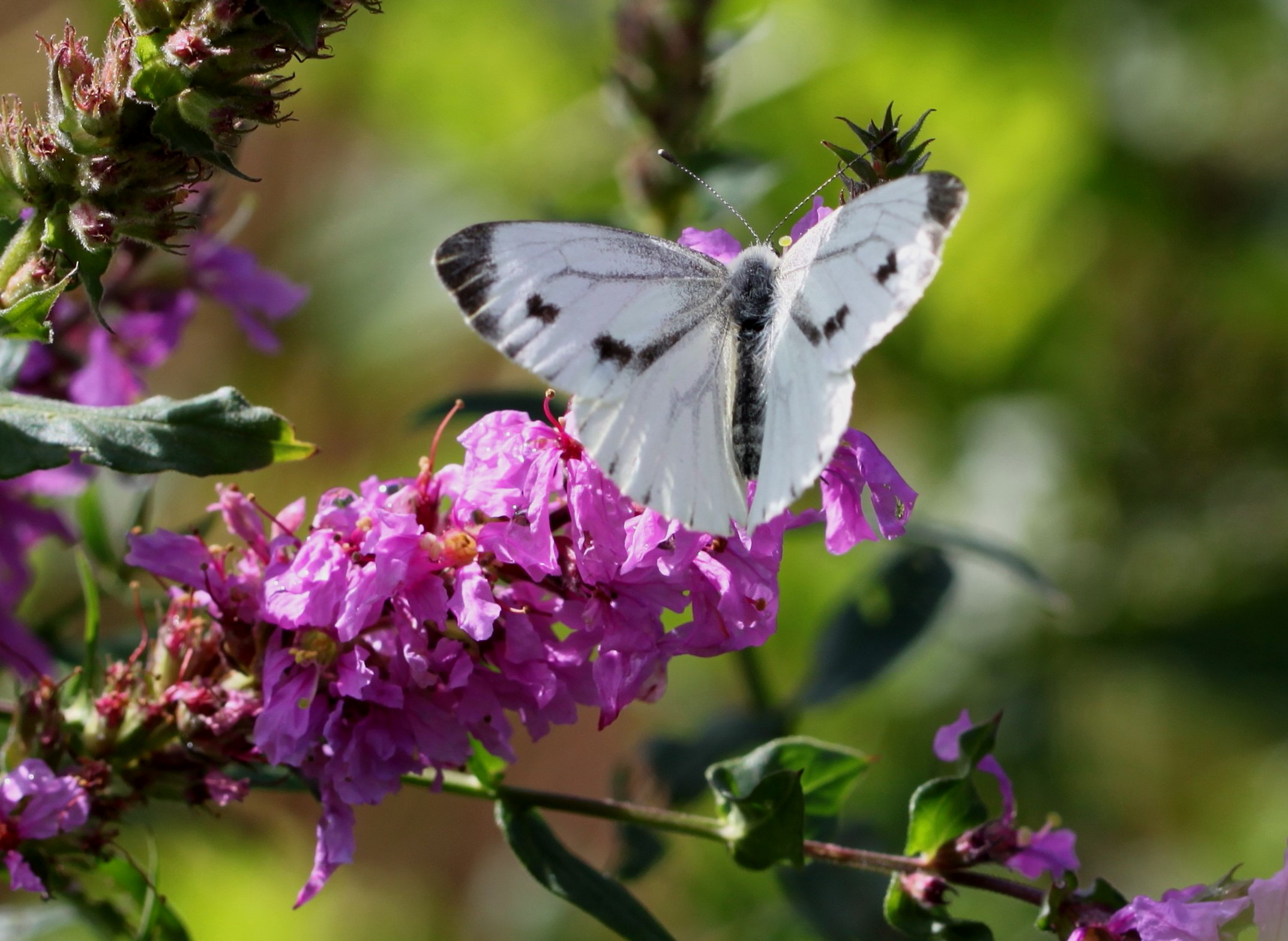
Second-brood female with open wings, nectaring on Purple Loosestrife
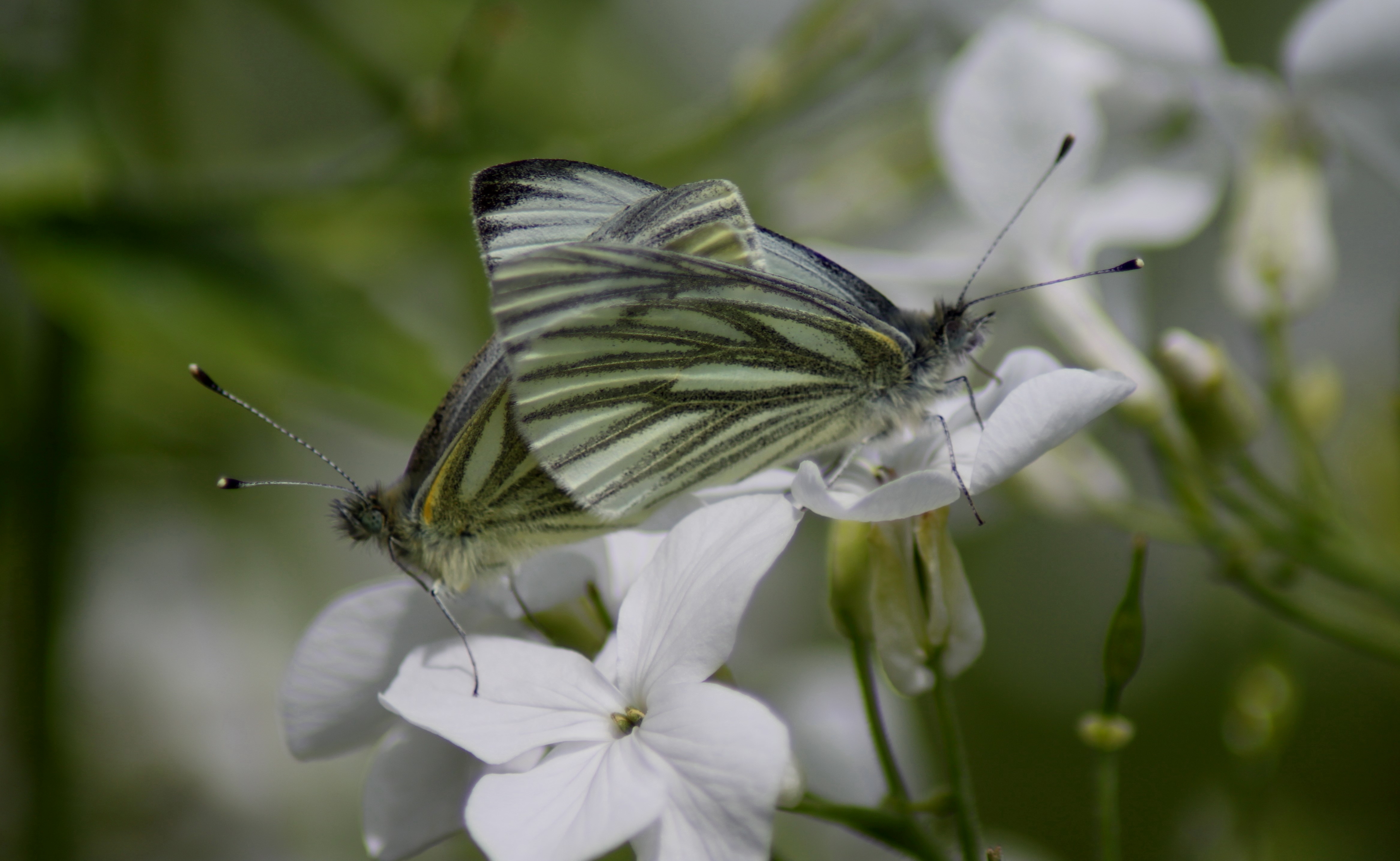
A mating pair
Butterfly Conservation Green-veined White