.JPG)
Celastrina argiolus
This is a woodland species which may be found in a sheltered sunny glade, along a mature hedgerow, and of course, in our gardens. It is widely distributed throughout the county, but nowhere can it be considered especially common. Holly Blue numbers vary enormously within a 4-6 year cycle, and this cycle is largely driven by its parasitoid, the Ichneumon wasp Listrodomus nycthemerus. The butterfly flourishes for a few years with the parasitic wasp lagging behind, but once wasp numbers reach a critical level, very few Holly Blue caterpillars escape the long stiletto of death, and the Holly Blue population crashes. In turn, the fortunes of the Ichneumon wasp plummet, and the cycle repeats itself, all over again.
In flight it could be confused with a Common Blue, but when perched, the silver background and black marks of the undersides are very distinctive.
The “average first sighting” between 2006-2024 was April 3rd (range from February 10th to April 23rd), and this first brood can be seen throughout May, and most of June. Second brood adults appear sometime in early July and are with us until late September. In the 21st century, this species regularly has a third brood. In the previous century it was only recorded in just nine years but since the year 2000 a third brood has become very regular, and since 2016, an annual event. The Holly Blue season is getting longer and longer and since 2016 there have been regular reports in November. In 2021, there was a new county record for the “latest sighting” when two females were recorded at Lancing on 01/12/2021. This record, sent in by Lindsay Morris, was rather special, for it meant that Holly Blue had joined a very select group of butterfly species that has been recorded in Sussex, in every month of the year.
Holly Blues typically lay their eggs on the flower buds and unripe berries of Holly and Dogwood, in the spring, and the flower buds of Ivy, in the summer. The list of other plants that are sometimes used is very long and includes Portuguese Laurel, Alder Buckthorn, Spindle, Snowberry, Cotoneaster, Euonymus, to name but a few. This catholic taste may explain why this species is relatively common in gardens and it may also explain why some gardens (including my Storrington garden) seems to largely escape the 4-6 year boom and bust cycles that are driven by parasitic wasps. It is quite possible that Listrodomus nycthemerus systematically searches all my garden Holly and Dogwood, in the spring, but neglects the Portugues Laurel, where most of the eggs are laid.
Anywhere in Sussex, but especially in mature gardens. If you see a blue butterfly in your garden then 99 times out of a 100 it will be a Holly Blue. Large numbers are not often recorded but a record for 37 Holly Blues at Lancing Ring in 2018 must have been very memorable.
Holly Blue nectaring on Bramble blossom – photo by Martin Kalaher
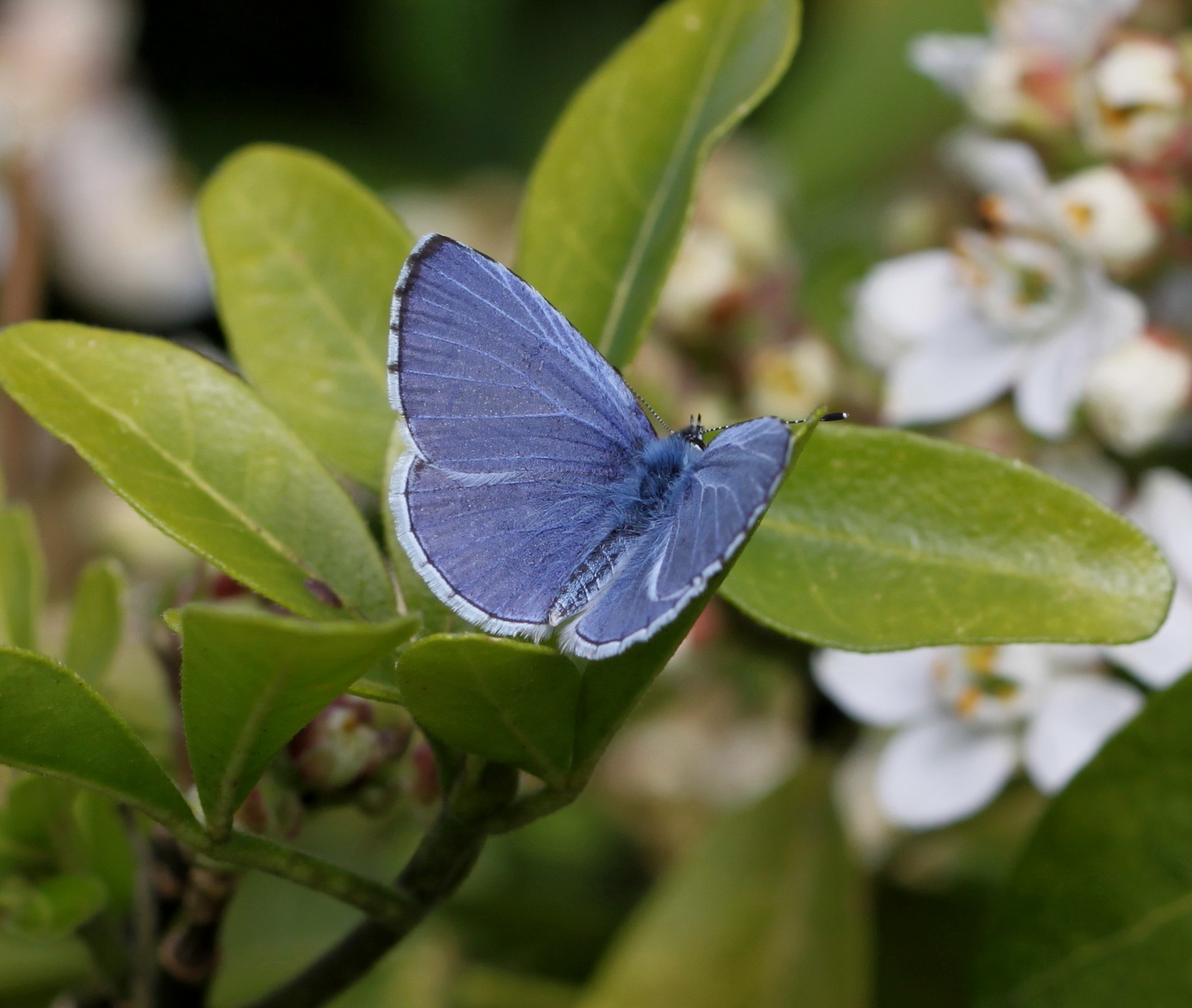
Male with open wings
.JPG)
Female with open wings
.JPG)
Female with closed wings
.JPG)
Female nectaring on Greater Celandine
.JPG)
Egg-laying on Dogwood
Butterfly Conservation Holly Blue